
tl;dr
RAM provides a fast, differentiable surrogate for pose reachability across morphologies, enabling rapid design and planning workflows.
Abstract
Many stages of the robotic lifecycle, from morphology synthesis to operation, rely fundamentally on the reachable workspace. However, current methods for approximating workspaces are slow, imprecise, or tied to a single morphology. We introduce Reachability Across Morphologies (RAM): a morphology-conditioned, implicit neural representation that acts as a fast, differentiable surrogate for pose reachability, generalising to unseen morphologies while inherently accounting for self-collisions. RAM is trained on a large-scale dataset of $3 \cdot 10^{10}$ samples generated solely from forward kinematics, which we publish alongside the model. Experiments show that RAM reaches $84\%$ balanced accuracy at nanosecond inference, 15 percentage points higher than a generative inverse kinematics baseline that also generalises across morphologies, while running three orders of magnitude faster. This speed carries over to downstream tasks, accelerating morphology and trajectory optimisation by one to two orders of magnitude.
Highlights
RAM
A morphology-conditioned implicit neural representation that evaluates pose reachability in nanoseconds, generalises to unseen morphologies without retraining, and inherently accounts for self-collisions.
Large-scale Reachability Dataset
A public dataset of \(3\cdot10^{10}\) samples across \(3\cdot10^4\) unique robot morphologies, generated solely from forward kinematics and self-collision queries, with pose sampling restricted to geometrically plausible regions.
Accelerating Morphology &
Trajectory Optimisation
RAM's differentiability and speed accelerate morphology and trajectory optimisation by one to two orders of magnitude compared to numerical inverse kinematics.
Summary
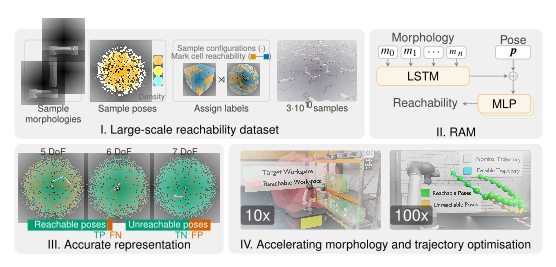
RAM Overview: We present RAM, a surrogate model for robot reachability. Trained on a diverse dataset of thirty billion samples (I), the morphology-conditioned implicit neural representation (II) generalises accurately to unseen morphologies (III). Due to its differentiability and efficient inference, RAM can substantially accelerate downstream robotics tasks by replacing inverse kinematics (IV).
Dataset
Samples
\(3\cdot10^{10}\)
Morphologies
\(3\cdot10^{4}\)
Dataset Size
204 GB
GPU Hours (H100)
360
Morphology
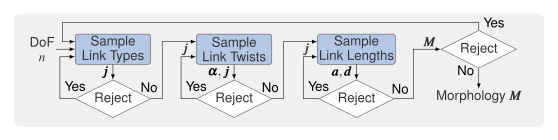
Serial kinematic chains of 5–7 revolute joints are sampled via hierarchical rejection sampling over Modified Denavit-Hartenberg parameters, yielding uniform coverage of the valid morphological space and covering operable, non-degenerate, conventional designs.
Pose
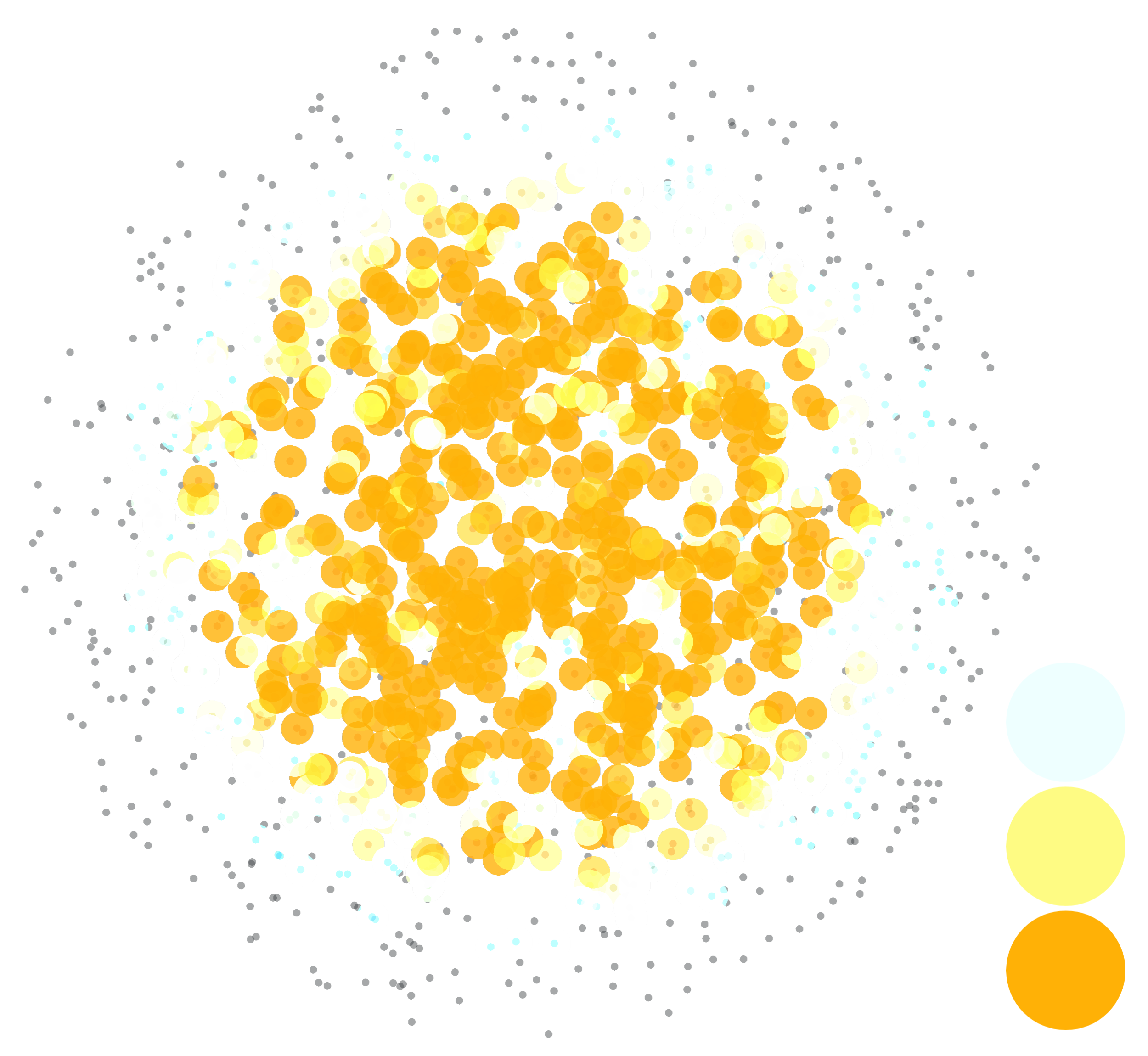
Poses are sampled uniformly from \(\mathcal{B}^3(t_0, r_\text{mov}) \rtimes SO(3)\), the geometrically plausible region centred at the first joint with moveable length \(r_\text{mov}\). This concentrates samples where the robot can actually reach, maximising the learning signal.
Reachability Label
\(SE(3)\) is discretised into cubic \(\mathbb{R}^3\) cells and \(SO(3)\) cells from a tessellation of the 600-cell. Collision-free joint configurations are sampled via forward kinematics to mark cells reachable, yielding labels with an expected balanced accuracy of 87% against inverse kinematics references — a practical ceiling for RAM.

Results
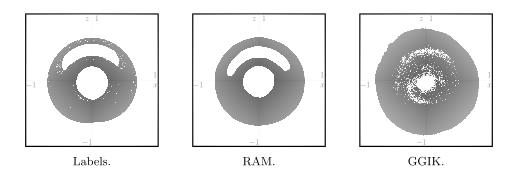
Workspace slices. A fixed-orientation cross-section through a representative workspace, showing ground-truth labels, RAM's prediction, and the GGIK baseline. RAM closely tracks the ground-truth boundary while GGIK produces a blurrier, over-smoothed approximation. Most of RAM's errors are false positives at the boundary, a slight dilation inherited from the over-approximating training labels.
RAM vs. GGIK
Inference measured end-to-end from pose and morphology input to reachability output.
| Classifier | Training (h) | Inference (s) | Balanced Acc. Random (%) | Balanced Acc. Boundary (%) |
|---|---|---|---|---|
| RAM (ours) | 21 | \(1.5 \cdot 10^{-7}\) | \(84^{+0}_{-0}\) | \(72^{+1}_{-1}\) |
| GGIK | 756 | \(2.2 \cdot 10^{-2}\) | \(69\) | \(62^{+1}_{-1}\) |
RAM outperforms GGIK by 15 percentage points in balanced accuracy on random poses and by 10 on boundary poses. Even GGIK's isolated model query (83 µs) is about three orders of magnitude slower, and RAM trains in less than a day versus roughly a month.
Out-of-distribution generalisation. Evaluated on morphologies with 1–4, 8, and 9 DoF and on spherical wrists, RAM roughly maintains its in-distribution balanced accuracy for three and four DoF and for spherical wrists, with four DoF even exceeding it by 4 percentage points. For one and two DoF, whose workspaces are lower-dimensional submanifolds of \(SE(3)\), RAM fails gracefully by predominantly predicting unreachable, while accuracy degrades more gradually towards eight and nine DoF.
Cost of generalisation. Compared with reachability maps and RAMs trained on a single morphology, the 16-percentage-point gap to perfect balanced accuracy decomposes into 13 points from label quality, 1 point from the neural approximation, and only 2 points from generalising across morphologies.
Latent space. Across principal components of the LSTM latent space, DoF shows the highest Spearman correlation (87%), followed by the fraction of reachable poses (65%). Latent distances correlate more strongly with workspace distances (49%) than with kinematic parameter distances (38%), indicating that the encoder organises morphologies by their reachability rather than by their parameters alone.
Applications
Replacing numerical inverse kinematics with RAM trades a modest amount of solution quality for large speed-ups, with both gradient-based (Adam) and gradient-free (CMA-ES) optimisers.
Morphology Optimisation
Link lengths and offsets of 1000 six-DoF morphologies are optimised to reach 100 task poses each. RAM is 7× faster with Adam and 21× faster with CMA-ES, at the cost of 8 and 9 percentage points of reached poses, respectively. Under Adam, RAM even reduces self-collisions more than the IK baseline.
Trajectory Optimisation
Waypoints on a nominal trajectory are perturbed in \(SE(3)\) tangent space to improve reachability. RAM is 22× faster with Adam and 60× faster with CMA-ES than the implicit-differentiation IK baseline, at the cost of 4 and 8 percentage points of reached poses and larger deviations from the nominal trajectory.
BibTeX
@inproceedings{
RAM,
title={{RAM}: Reachability Across Morphologies},
author={Walter, Tim and Chen, Xinyu and K{\"u}lz, Jonathan and Althoff, Matthias},
booktitle={10th Annual Conference on Robot Learning},
year={2026},
url={https://arxiv.org/abs/2606.09108}
}